The Ultimate Guide to Startup Growth Strategies in 2026
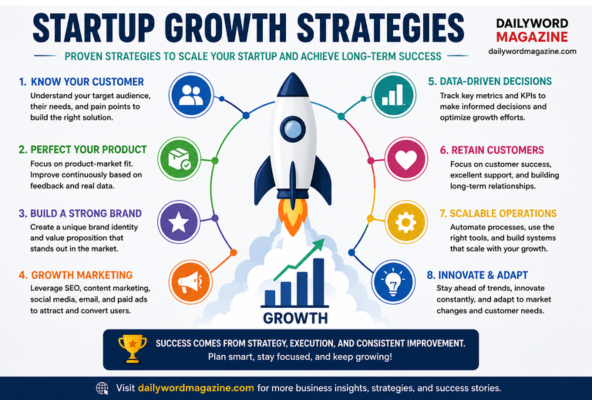
Startup Growth Strategies That’ll Get You Closer to Product-Market Fit
Achieving product-market fit is the biggest milestone for any startup Growth Strategies
Start by talking to real customers and understanding their biggest pain points.
Build a minimum viable product (MVP) that solves one problem exceptionally well.
Collect user feedback regularly and improve your product based on real data.
Track key metrics like customer retention, engagement, and churn instead of vanity metrics.
Focus on one target audience before expanding into new markets.
Create a simple and repeatable customer acquisition strategy using SEO, social media, or referrals.
Continuously test pricing, messaging, and features to discover what resonates most with users.
Build a strong community of early adopters who can provide feedback and spread the word.
Stay agile, iterate quickly, and never stop learning from your customers to move closer to product-market fit.
Startup Growth Strategies That Market Leaders Follow
- Focus on Customer Problems First – Successful startups build products that solve real customer pain points instead of chasing trends.
- Use data to make decisions. Market leaders track key metrics like customer acquisition cost (CAC), lifetime value (LTV), and retention. They use these metrics to guide growth.
- Build a Strong Brand – A clear brand identity and consistent messaging help startups earn trust and stand out from competitors.
- Experiment and Iterate Quickly – Leading companies continuously test new features, pricing, and marketing strategies based on customer feedback.
- Invest in customer retention. Keep current customers happy with strong support and better products. This is often more profitable than finding new customers.
What Growth Strategies Are Best for Startups? What Are the 7 Stages of a Startup?
What Growth Strategies Are Best for Startups?
The most effective startup growth strategies focus on sustainable, long-term success rather than rapid expansion alone. Here are five proven strategies:
- Validate product-market fit. Build a product that solves a real customer problem. Keep improving it using user feedback.
- Invest in Content and SEO – Publish valuable content that attracts organic traffic and builds brand authority over time.
- Use Data-Driven Marketing – Track metrics like customer acquisition cost (CAC), customer lifetime value (LTV), and retention to optimize growth.
- Build Referral and Partnership Programs – Encourage existing customers and strategic partners to bring in new users.
- Focus on Customer Retention – Happy customers are more likely to stay, recommend your product, and increase recurring revenue.
What Are the 7 Stages of a Startup?
- Idea Stage – Identify a problem and develop a business concept.
- Validation Stage – Research the market, test assumptions, and confirm customer demand.
- MVP Stage – Launch a Minimum Viable Product to collect real-world feedback.
- Product-Market Fit Stage – Refine the product until it consistently meets customer needs and gains traction.
- Growth Stage – Scale customer acquisition, expand marketing efforts, and grow revenue.
- Expansion Stage – Enter new markets, launch new products, and build a larger team.
- Maturity or Exit Stage – Achieve sustainable profitability or pursue an acquisition, merger, or initial public offering (IPO).
Startup Growth Strategy & Planning Tips
1. Define Clear Business Goals
Set specific, measurable, achievable, relevant, and time-bound (SMART) goals that align with your startup’s vision.
2. Validate Product-Market Fit
Ensure your product solves a real customer problem by collecting feedback, testing features, and making continuous improvements.
3. Identify Your Target Audience
Research your ideal customers, understand their needs, and create detailed buyer personas to guide marketing and product decisions.
4. Build a Scalable Marketing Strategy
Use SEO, content marketing, social media, email campaigns, and paid advertising to attract and convert potential customers.
5. Track Key Performance Metrics
Monitor key KPIs like customer acquisition cost (CAC) and customer lifetime value (LTV). Track monthly recurring revenue (MRR), retention, and churn.
6. Create a Strong Sales and Customer Success Process
Develop an efficient sales funnel, provide excellent customer support, and focus on retaining customers to maximize long-term growth.
7. Optimize Operations and Finances
Manage cash flow carefully, automate repetitive tasks, and streamline business operations to improve efficiency and profitability.
8. Scale Strategically
Expand into new markets. Hire the right talent. Build strategic partnerships. Keep innovating. Maintain high product quality and strong customer satisfaction.
A well-planned growth strategy helps startups lower risk, make better decisions, and build a strong base for long-term success.
How to Develop Business Growth Strategies That Drive Long-Term Success
Developing an effective business growth strategy requires careful planning, market research, and continuous improvement. Follow these key steps to create a strategy that delivers sustainable results.
1. Set Clear Business Goals
Define specific, measurable objectives such as increasing revenue, expanding your customer base, or entering new markets.
2. Understand Your Target Market
Research your ideal customers, analyze their needs, and study your competitors to identify growth opportunities.
3. Strengthen Your Value Proposition
Clearly communicate what makes your product or service unique and why customers should choose your business over competitors.
4. Create a Scalable Marketing Plan
Use SEO, content marketing, social media, email campaigns, partnerships, and paid advertising to attract and convert customers.
5. Focus on Customer Retention
Deliver excellent customer experiences, provide responsive support, and build loyalty through personalized communication and rewards.
6. Measure Performance with Key Metrics
Track KPIs such as customer acquisition cost (CAC), customer lifetime value (LTV), conversion rate, retention rate, and revenue growth to evaluate success.
7. Adapt and Improve Continuously
Regularly review performance data, gather customer feedback, test new ideas, and refine your strategy to stay competitive in a changing market.
A successful business growth strategy combines customer insight, data-driven decisions, and consistent execution to achieve long-term, sustainable growth.
Growth Strategies for Startups That Want to Scale Up
Scaling a startup takes more than a great product. It needs a clear growth plan, efficient operations, and a strong understanding of customers. Here are eight proven strategies to help your startup grow sustainably.
1. Achieve Product-Market Fit
Before scaling, ensure your product solves a real customer problem. Gather feedback, improve your offering, and validate demand.
2. Define Your Ideal Customer
Identify your target audience and create detailed buyer personas. Focusing on the right customers improves marketing effectiveness and conversion rates.
3. Invest in Content Marketing and SEO
Publish high-quality blog posts, guides, and case studies to attract organic traffic, build authority, and generate qualified leads.
4. Build a Scalable Customer Acquisition Strategy
Use a mix of SEO, social media, email marketing, paid advertising, referrals, and partnerships to acquire customers consistently.
5. Focus on Customer Retention
Retaining existing customers is more cost-effective than acquiring new ones. Deliver excellent support, regular product updates, and personalized experiences.
6. Track Growth Metrics
Monitor key performance indicators (KPIs) like Customer Acquisition Cost (CAC) and Customer Lifetime Value (LTV).
Track Monthly Recurring Revenue (MRR), churn rate, and customer retention.
7. Automate and Optimize Operations
Use automation tools for marketing, sales, customer support, and internal workflows to improve efficiency as your business grows.
8. Scale Your Team and Partnerships
Hire talented employees, build strategic partnerships, and create processes that support long-term expansion without sacrificing quality.
Growth Strategy for Start-Up Businesses: Analysis
A successful startup growth strategy begins with identifying a clear target market and validating product-market fit. Businesses should focus on acquiring customers through cost-effective marketing channels such as SEO, social media, and referrals. Tracking key performance indicators (KPIs) helps founders make data-driven decisions and optimize growth efforts. Strong customer retention, continuous innovation, and efficient operations create a foundation for sustainable scaling. By adapting to market changes and customer feedback, startups can achieve long-term business success.
Proven Startup Growth Strategies That Actually Work
Successful startups grow by solving real customer problems and continuously improving their products based on user feedback. They use cost-effective acquisition channels such as SEO, content marketing, referrals, and social media to attract qualified customers. Data-driven decision-making helps optimize marketing campaigns, product features, and customer experiences. Market leaders also prioritize customer retention through exceptional support and ongoing product improvements. By combining innovation, scalability, and operational efficiency, startups can achieve sustainable long-term growth.
Harvard Business Review: Ideas and Advice for Leaders
Harvard Business Review (HBR) says steady business growth needs strong leadership.
It also needs innovation that focuses on customers.
It also needs decisions based on data. Successful leaders create clear strategies, build high-performing teams, and adapt quickly to changing market conditions. HBR also highlights the importance of continuous learning, operational excellence, and long-term value creation over short-term gains. By fostering innovation and maintaining a customer-first mindset, businesses can strengthen their competitive advantage and achieve sustainable growth.
Conclusion
Building a successful startup requires a clear Startup Growth Strategies customer-focused innovation, and continuous improvement. By validating product-market fit, leveraging data-driven decisions, investing in marketing, and prioritizing customer retention, startups can achieve sustainable growth. Consistently adapting to market trends and customer feedback helps businesses scale efficiently and keep a competitive edge over time.













Post Comment